Championing Change – A Culture of Alignment
January 29, 2009 Leave a comment
 Rather than viewing change management as a series of periodic events in which a new program or initiative must be “rolled out,” consider fostering a culture of alignment. In a culture of alignment, employees’ values, perspectives, and priorities are “aligned” with the overall strategic direction of the company or team. Simply put from a management point of view, they “get it,” and are able to view the business from the company’s perspective (as well as their own). They may not agree with every individual directive or initiative, but they trust their leaders and subsequently accept or even embrace decisions that are made, even those that are unpopular. Change is viewed more as an evolutionary process than a series of periodic singular events. When new initiatives are brought forward, team members feel more engaged in the evolutionary process and have a greater comfort level toward any potential impact. Rather than becoming overwhelmed by fear and trepidation at something new, they maintain a viewpoint focused on the immediate opportunities and longer term benefits.
Now all this sounds well and good, but let’s be honest, there are times when initiatives presented from above are viewed as flawed, implausible, even unrealistic. This creates a critical juncture for a leader and his or her team. Failing to acknowledge obvious problems and blindly repeating scripted expectations undermines a leader’s credibility. This is management, not leadership. As I stated earlier, leaders must have the courage to appropriately challenge assumptions and question superiors. On the other hand, organizations rightfully expect their managers to sometimes just tow the line and enthusiastically implement new initiatives.
In many cases, managers are afforded enough discretionary license to adapt the implementation of an initiative to align with the strength of the team and better respond to specific business needs. In these situations, the emphasis is on the end objective rather than the means. Reviewing the objectives with all team members and involving them in developing an action plan for implementation builds consensus and instills a sense of ownership. People are far more likely to own a problem when they participate in designing the solution.
However, there are times when the mandate leaves no room for interpretation, or when the emphasis is on the means itself as well as the end objective. Here, a team’s culture of alignment is truly put to the test and strong leadership becomes crucial. Even in disagreement, a healthy, aligned team will embrace the solution together, but only with the leader’s support and assistance. A leader doesn’t necessarily have to agree with the merits of every directive, but he absolutely must believe in and support the organization’s overall vision of success. He must also believe in his team’s ability to accomplish the goals set forth, and champion their effort toward achieving the overall objective.
The point is, affecting change within any team or organization means altering the status quo in some way. Teams with a strong culture of alignment are far less resistant to change because the idea of change itself is less threatening. Let’s face it, most people dislike change. There is some level of comfort even in the consistency of misery. Teams that operate within a culture of alignment may never enthusiastically embrace the idea of change, but will nevertheless accept change as a systemic component of their ongoing growth and success. These team members trust their leader and their values are fundamentally aligned with the general vision and mission of the organization.
Next Post: Developing a Culture of Alignment
 An experiment was conducted back in the late 19th century in which a frog was placed in very hot water. Immediately sensing danger from the extreme heat, the frog jumped out to safety. However, placing the frog in cool water and slowly raising the temperature resulted in the frog getting groggier and groggier, and finally boiling to death.
 Vision is the fifth attribute common to superior leaders. Usually, the word “vision” in leadership brings to mind lofty, high level ideals – a long term strategic objective. But leaders with vision do more than align staff members with a company’s mission or rally the public around a common cause.
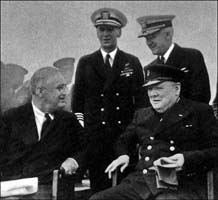
 Winston Churchill said, “Courage is what it takes to stand up and speak; courage is also what it takes to sit down and listen.” This quote from one of the 20th century’s greatest leaders holds a wealth of wisdom in its simplicity. No one would argue that it often requires courage to take action. It’s easy in times of conflict to sit back and let others do the dirty work. But it also takes courage at times to not act immediately, especially when confronted with adversity. Knowing when to intervene and when to let events run their course comes with experience and confidence. Courageous leaders calmly assess the situation and explore alternatives, even as others respond emotionally, demanding swift action. This measured response to adversity requires discipline and the courage to be steadfast.
 The third attribute demonstrated by superior leaders is often the most elusive and under-appreciated. The very concept of humility rarely crosses the mind of most people in positions of authority. It is simply not how we are typically conditioned to think. Our culture champions the loud, the bold, and the brazen. I stated early on that we live in a self-centric society. It’s the “me” generation – self-absorbed, self-centered, self-inflated, narcissistic, entitled, demanding instant gratification, and lacking any sense of personal responsibility. This is the age of entitlement. At the risk of sounding like somebody’s grandfather, today’s generation is vapid and superficial, placing more value on appearance than character.
 As I wrote in my last post, personal discipline, as it contributes to strength of character, ensures we are guided by principle rather than emotion or personal desire. In that context, self-discipline, resilience, and integrity all go hand in hand. But in a much broader sense, the discipline that strong leaders demonstrate reflects much more than mere self-control.
 Strength of character, as the blog title implies, is one of the most important attributes of a leader. As I stated earlier, effective leaders must have credibility, the trust and confidence of others. Key to this is a strong sense of integrity. Integrity is built on honesty and the consistent, steadfast adherence to established principles and standards. Strong leadership is dependent upon character, and character is certainly measured, if not defined, by integrity.
 The Character of Leadership
Recent Comments